May 3, 2026 · Limbo Crew
Splitting Airbnb Costs With Friends (Even When the Rooms Aren't Even)
The master suite shouldn't cost the same as the bunk room. A simple room-weighting method to split an Airbnb fairly, worked example and crew scripts included.
Splitting an Airbnb unevenly, in 30 seconds: split half the total cost evenly across everyone (you're all using the same kitchen, pool, and living room) and split the other half by room quality. Score each room, divide that second half by the scores, and add the two numbers together. Done. A $2,400 house for six doesn't have to mean $400 each when two of you landed the ensuite king and two of you are sharing a bunk room. Below: the exact math, a worked example you can copy, and the message to send your crew before anyone books.
The problem with "let's just split it evenly"
You know the moment. Someone drops the listing in the chat (pool, six beds, walkable to everything) and someone else replies "$400 each, who's in?" Everyone's in. Nobody looks too closely at the floor plan.
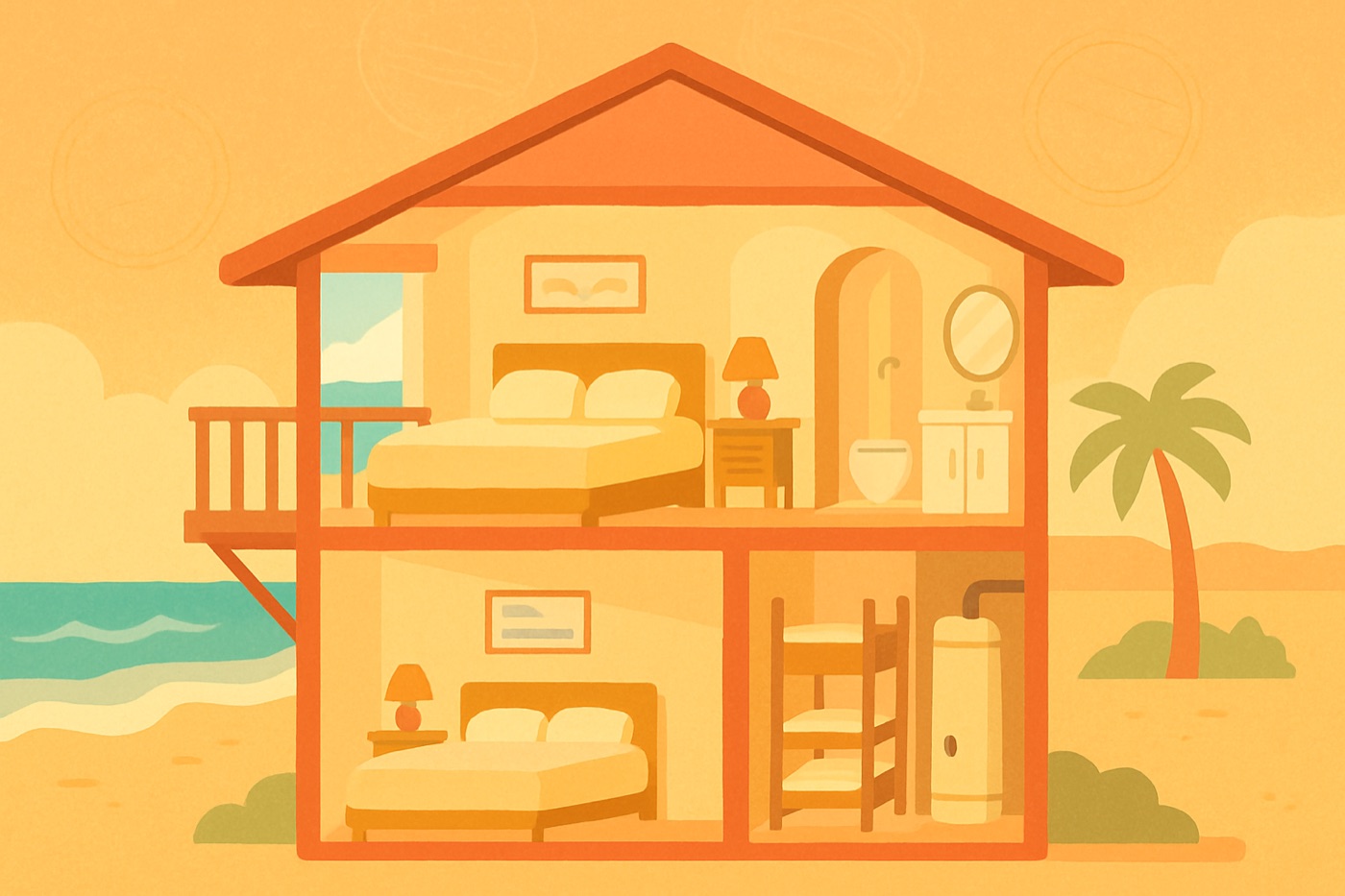
Then you arrive, and the floor plan looks at you. The couple who booked it drift upstairs to a master suite with an ensuite and a balcony. And two of your crew are standing in the doorway of "Bedroom 4," which is a bunk bed in what is legally a closet, doing the quiet math: we paid the same as the balcony people.
Nobody says anything, of course. That's the problem. Uneven rooms on an even split don't cause arguments, they cause a low-grade resentment that outlasts the tan. The fix is ten minutes of math before booking. Here's the whole playbook. (For the bigger picture, meals, activities, who-owes-whom, start with our full guide to splitting costs on a group trip.)
Step 1: Decide if an uneven split is even worth it
First, an honest gate: not every house needs this. If the rooms are roughly comparable (two queens and a slightly bigger queen) split evenly and spend your energy arguing about dinner instead. A weighted split is a small negotiation, and negotiations have a friendship tax.
Our rule of thumb: go uneven when the gap between the best and worst sleeping situation is worth more than about $25 per person per night. Ensuite king versus shared bunk room? Weight it. Balcony versus no balcony? Let it go.
Also worth weighting:
- Longer stays. A $20/night gap is $60 on a weekend but $280 on a two-week villa.
- Budget-sensitive crews. If one friend stretched to say yes, the cheap-room discount might be the thing that keeps them on the trip.
- A sofa bed in the mix. Anyone sleeping in a common room is donating their privacy to the group. Pay them for it.
If you're in "let it go" territory, close this tab and go plan something fun. Still here? Good, the math is genuinely easy.
Step 2: Split the house in half, the 50/50 rule
The mistake people make with uneven splits is treating the booking like you're each renting a bedroom. You're not. You're renting a house, and the pool, the kitchen, the long table where everyone ends up at 1am are the whole reason you booked together instead of getting hotel rooms.
So split the cost in two halves:
- The house half (50%): split evenly per person. Everyone gets the same kitchen, the same pool, the same sunset deck.
- The room half (50%): split by room quality. This is where the master suite pays its dues.
Why 50/50 and not, say, 70/30? Because it's the ratio nobody argues with. It says "we're in this together" and "the balcony isn't free" in the same breath. If your house is basically all bedrooms and no shared space, nudge the room half up to 60%. Don't go further. Past that, it stops feeling like a group trip and starts feeling like a hostel with assigned seating.
Step 3: Score the rooms (before anyone claims one)
Now put a number on each room. Keep it crude, this is a vibe check with digits, not an appraisal:
- Start every room at 5.
- +2 for a private ensuite
- +1 for a king or queen (versus twins or a bunk)
- +1 for a real perk: balcony, view, top-floor quiet
- −1 if it shares a bathroom with the hallway rush hour
- −2 for bunks, sofa beds, or anything you'd describe with air quotes
One critical rule: score the rooms before anyone picks one. Scoring blind keeps everyone honest, it's amazing how objective people get about the bunk room when they might end up in it. If rooms are already claimed, you can still do this, but expect the master-suite residents to suddenly develop strong opinions about how little a balcony matters.
(Deciding who actually gets which room is its own sport: draft, lottery, pay-more-pick-first. Same idea works for hotels too; see how to split hotel costs with friends.)
Step 4: Do the math, a worked example
Let's run a real one. Six friends, four nights, $2,400 total. Three rooms: a master suite (couple), a queen room (couple), and a bunk room (two singles).
House half: $1,200 ÷ 6 people = $200 each. Everyone pays it. Nobody debates it.
Room half: $1,200, divided by room scores. The master scores 10 (5 + ensuite + king + balcony), the queen room scores 6 (5 + queen, shares a bathroom), the bunk room scores 4 (5 + 1 for the mini fridge someone found, − 2 for bunks). Total: 20 points. Each point is worth $1,200 ÷ 20 = $60. A room's share splits between the people sleeping in it.
| Room | Score | Room share | Per person (room) | + House share | Total per person | vs. even split ($400) |
|---|---|---|---|---|---|---|
| Master suite (2) | 10 | $600 | $300 | $200 | $500 | +$100 |
| Queen room (2) | 6 | $360 | $180 | $200 | $380 | −$20 |
| Bunk room (2) | 4 | $240 | $120 | $200 | $320 | −$80 |
Sanity check: (2 × $500) + (2 × $380) + (2 × $320) = $2,400. ✅
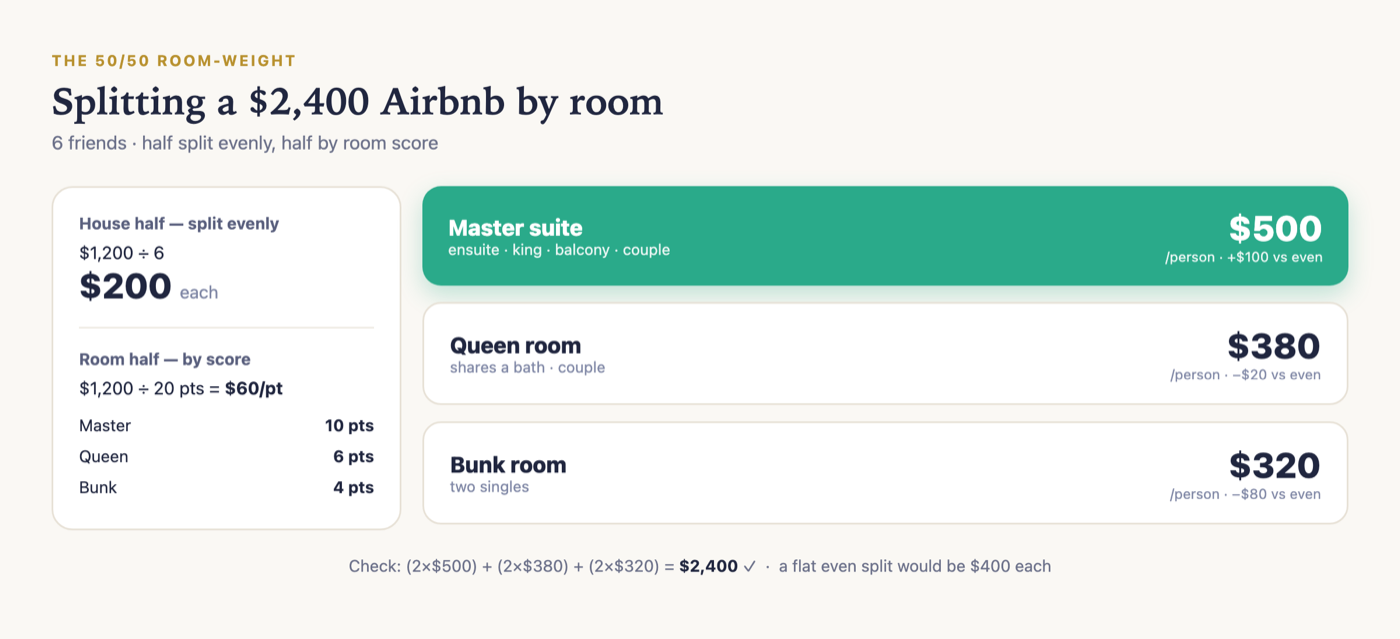
Look at those gaps: the balcony couple pays $100 more each, the bunk crew saves $80 each. Big enough to feel fair, small enough that nobody feels fined. That's the sweet spot. If your numbers come out with someone paying double someone else, your scores are probably too dramatic. Soften them.
Step 5: Handle couples, solos, and the sofa-bed hero
Three situations that trip people up:
Couples. Split per person, not per room. In the example above, the master couple pays $500 each, a solo traveler in that same master would pay $200 (house) + $600 (the whole room share) = $800. That's not a punishment; it's the honest price of a private suite. It's also why solos usually take the smaller rooms and couples take the big ones, the math nudges everyone toward the arrangement that already makes sense.
The sofa-bed hero. Someone volunteering to sleep in the living room deserves a real discount, not a symbolic one. Score the sofa a 2 or 3, or exempt them from the room half entirely and just charge the house half. They gave up having a door. Doors are worth money.
Fees. Cleaning fees, service fees, and damage deposits are headcount costs, not room costs, the cleaner doesn't charge extra for the balcony. Split those evenly, on top of whatever the rooms work out to. (They can quietly add 25%+ to the sticker price, so read the fee-splitting breakdown before you quote your crew a number.)
Step 6: Lock it in before you book (and track it after)
The room-weighted split only works if everyone agrees to it before the booking is made and the rooms are claimed. After that, you're not proposing a system, you're presenting a bill. Send something like this with the listing:
"Okay, THIS house 🏝️ $2,400 total for 4 nights. Rooms aren't equal so proposing we don't pay equal: master couple $500 each, queen room $380 each, bunk room $320 each (half split evenly, half by room). Yell now or forever hold your Venmo. Who wants which room?"
Notice the trick: the message contains the actual per-person numbers, not a link to a philosophy. People say yes to numbers.
Then, and this is the part everyone skips, write the split down somewhere that isn't the group chat. By day three of the trip, "wait, what did we say the bunk room pays?" should have an answer nobody has to scroll for. This is exactly what we built Limbo's custom splits for: set each person's percentage once (in our example, the master couple at ~21% each, queen at ~16%, bunks at ~13%), and every lodging payment splits itself, the crew sees the same numbers, no treasurer required.
What usually goes wrong
Five ways this goes sideways, all preventable:
- Deciding after rooms are claimed. The single biggest mistake. Once people are unpacked, every negotiation is downhill. Numbers first, rooms second.
- Over-engineering it. If your spreadsheet weights square footage, mattress firmness, and morning sun exposure, you've built a second job, not a fair split. One score per room. Move on.
- Forgetting the fees. You quote everyone "$320" off the nightly rate, then the cleaning fee lands and suddenly you're re-collecting $38 from six people who thought they were done paying.
- The booker floating it all. One brave soul puts $2,400 on their card and then spends three weeks as a debt collector. Collect before the free-cancellation window closes, it's also the world's best flake detector.
- Nobody wants the cheap room, even cheaper. If the bunk room is genuinely grim, run a reverse auction: keep dropping its price (and raising the master's) until someone says "fine, at $250 I'll take the bunks." Someone always does.
FAQ
Should the person who found and booked the house pay less?
Tempting, but keep the room math and the "thank you" separate. Mixing labor into the lodging split turns one clean negotiation into two messy ones. Buy the booker dinner, cover their airport coffee, make them exempt from dish duty. Reward effort with gratitude, not a discount buried in the spreadsheet.
What if someone's only staying two of the four nights?
Pro-rate their house half by nights (2 of 4 nights = half of the $200 = $100 in our example). Their room half depends on the room: if it sits empty after they leave, they pay it in full; if someone rotates in off the sofa, split it by nights. Agree on this upfront, partial-stay math invented on the last morning never feels fair to anyone.
Do we split the cleaning fee by room weight too?
No, evenly, always. Fees scale with the group, not the view. Same for the damage deposit and any service fees. The room-weighting only ever applies to the rent itself.
Before you send that message to the chat: get the per-person numbers right, fees and all, a ten-minute room-score beats a week of quiet resentment. And if you want the split, the payments, and the who-owes-whom to just quietly handle themselves for the whole trip, that's the job Limbo was built for. Every core trip workflow is free.