April 26, 2026 · Limbo Crew
How to Split Costs on a Group Trip Without Losing Friends
The fair way to split group trip costs: pick a method before anyone pays, track who paid what, and settle once. Real numbers, worked examples, and the scripts.

The fair way to split costs on a group trip: agree on the method before anyone pays for a single thing, track every expense in one place with a note of who actually paid, split shared costs (the house, the rental car, groceries) evenly or by weighted shares, keep personal costs (flights, that solo massage) out of the pot, and settle up once, within a week of getting home.
That's the whole playbook in one paragraph. The rest of this guide is the part nobody writes down: the actual math, the awkward edge cases (unequal bedrooms, couples vs singles, the friend who ordered three cocktails) and the scripts for the conversations you'd rather not have.
Because here's the truth every group traveler learns eventually: trips don't fall apart over money. They fall apart over unspoken money.
Why do group trips go wrong over money?
Almost every trip-money blowup traces back to one of three moments:
- Nobody agreed on a method upfront. So when the $2,240 house bill lands, everyone quietly runs different math (per head? per room? per night stayed?) and everyone's number makes them the reasonable one.
- One person fronted everything and kept the ledger in their head. By day three they're owed four figures, they've lost track of the gas station snacks, and they feel like the group's unpaid accountant. (There's a name for this person, the trip treasurer, and they deserve better.)
- Settling up got postponed until it got weird. A $63 IOU at the airport is a two-tap payment. The same $63 three weeks later is an awkward text nobody wants to send.
All three have the same fix: decide how money works before it starts moving. Which brings us to the ten-minute conversation that saves the friendship.
What should you agree on before anyone pays?
Have this conversation before a single deposit goes out, in person, on the group call, wherever. It takes ten minutes. Four decisions:
1. The budget ceiling. Not "let's keep it reasonable", a number. "Are we all good with roughly $700 per person, all-in?" This is the single highest-leverage question in group travel, and it's exactly the kind of thing people won't answer honestly in a group chat where everyone can see who votes for "cheaper." (We've written a whole piece on talking money with friends before the trip, and if the answer is "actually, that's steep for me," here's what to do when someone can't afford the trip.)
2. The split method. Even, weighted, itemized, or hybrid: pick one (the next section shows you exactly when each works). Ninety seconds now, zero arguments later.
3. Who fronts the big stuff and how it gets tracked. Someone's card is taking the $2,000 lodging hit. Decide who, decide when they get paid back (before the trip, ideally, see collecting money before it gets awkward), and agree that every shared expense gets logged the day it happens. Not "we'll figure it out after."
4. The settle-up moment. Pick the day. "We settle the Sunday after we're back, everyone squares up within 48 hours of the final tally." Naming the moment upfront turns a personal favor ("hey, can you pay me back?") into group policy ("it's settle-up day").
Write the four answers in the group chat, pin the message, done.
What are the main ways to split group trip costs?
Four methods cover essentially every group trip. Here's the honest comparison:
| Method | How it works | Best for | Watch out for |
|---|---|---|---|
| Even split | Total shared costs ÷ number of people. Everyone pays the same. | Similar budgets, similar rooms, crews of 4–8 who'd rather be at the beach than in a spreadsheet | Feels unfair fast when rooms or consumption differ wildly |
| Weighted split | Shares set by percentage: bigger room, bigger share; kids or partial attendees at reduced shares | Unequal bedrooms, couples + singles, someone joining for 2 of 5 nights | Needs one honest 10-minute conversation to set the weights |
| Itemized | Every expense split only among the people it applies to | Mixed-activity trips (half the crew does the boat day), big spend gaps at dinners | Highest bookkeeping load: death by a thousand line items if you itemize everything |
| Hybrid (our pick) | Even split for true shared costs, weighted for lodging, itemized only for big opt-in extras | Most real trips | None, honestly: this is the one we'd tattoo on the group chat |
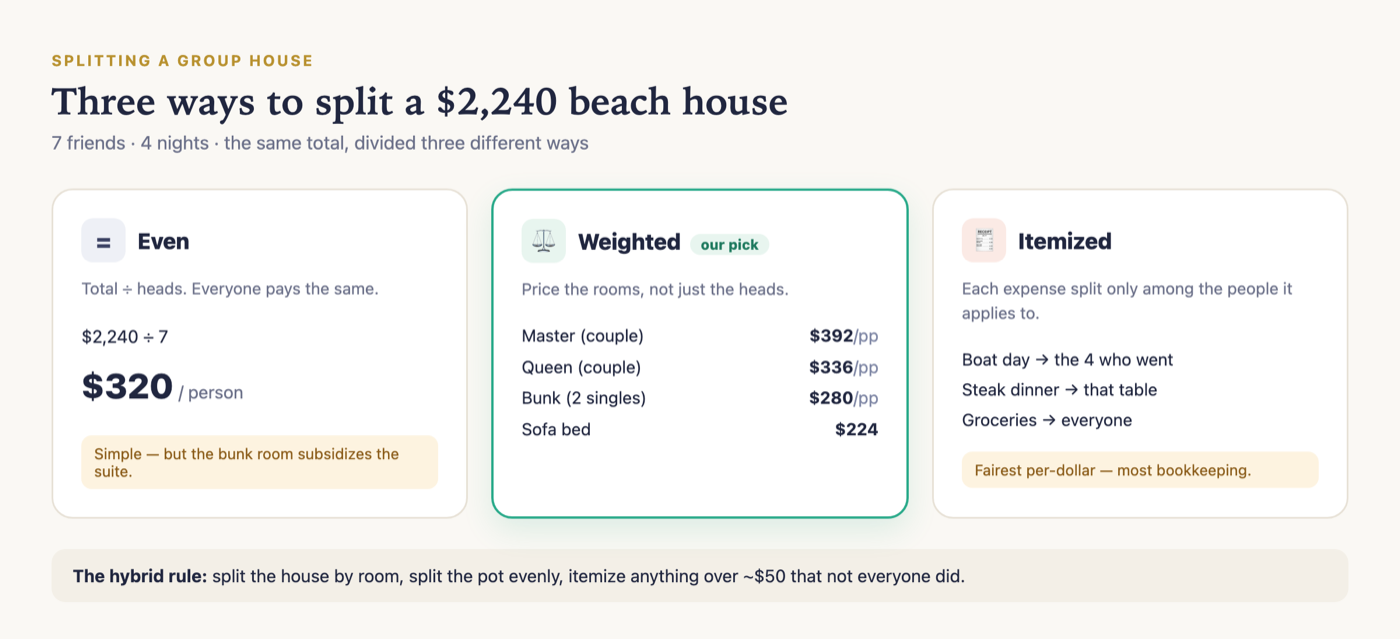
The hybrid rule of thumb, in one line: split the house by room, split the pot evenly, itemize anything over ~$50 that not everyone did.
How do you split accommodation fairly when the rooms aren't equal?
Lodging is usually 40–50% of a group trip's shared costs, and it's where even splits break down, because a master suite with an ensuite and an ocean view is not the same product as a bunk room next to the ice machine.
The fix: price the rooms, not the heads. Worked example with real numbers:
Seven friends, four nights, a $2,240 beach house (that's $560 a night, typical for a 4-bedroom rental in a mid-tier US beach town in 2026, fees included). The rooms:
- Master with ensuite (couple), clearly the best room: call it 35% → $784, or $392/person
- Queen room (couple), solid: 30% → $672, or $336/person
- Bunk room (two singles), fine: 25% → $560, or $280/person
- Sofa bed in the den (one brave soul), zero privacy: 10% → $224
Compare that to a flat even split: $2,240 ÷ 7 = $320 per person. The sofa-bed hero saves $96 and stops quietly resenting everyone; the master couple pays $72 more each for the room they were going to claim anyway. Total drama averted for the price of a nice dinner.
How to set the weights without a fight: put the room percentages to a quick vote before anyone's picked a room. People are remarkably fair when they don't yet know which room they're arguing for.
Two deeper dives if lodging is your sticking point: splitting Airbnb costs when the rooms aren't even (including what to do about cleaning fees and damage deposits) and splitting hotel costs across doubles, suites and solo rooms.
The couples question, since it always comes up: for lodging, couples sharing a bed should generally pay per room share, not double; they're consuming one room. For everything else (food, activities, gas), they're two people and pay two shares. Splitting the whole trip per-couple is how singles end up subsidizing everyone else's romance.
How should you handle food, groceries and restaurant bills?
Groceries: run a communal pot and never itemize. For a long weekend, $75–90 per person covers breakfasts, snacks, drinks and mixers for a typical crew. Everyone antes in (or one person pays and it goes in the ledger as an even split), and nobody, nobody, audits the oat milk. The person who doesn't drink coffee is drinking more of the wine. It evens out. It always evens out.
Restaurants: decide even-vs-itemized before you sit down, using the 2x rule. If everyone's ordering in the same range (entrée, a drink or two) split evenly and move on; the variance is a few dollars and the goodwill is worth more. But when one person's tab is going to run more than roughly double someone else's (the steak-and-three-cocktails vs. the $19 salad problem), itemize that meal without apology. The move is announcing it while menus are still open: "Big group, mixed orders, let's each cover our own plus even-split the shared stuff?" Said before ordering, it's logistics. Said when the bill lands, it's an accusation.
Alcohol deserves one honest sentence at the kickoff. If you've got a non-drinker (or a light drinker) in the crew, pull bar tabs and bottle-shop runs out of the communal pot and split them among the drinkers. It's a 30-second adjustment that the non-drinker will never ask for and will absolutely notice.
Who pays upfront, and how do you track it?
Big bookings need a fronter. Two rules keep the fronter sane:
Rule 1: Nobody carries more than they're comfortable losing. The house, the boat deposit, the rental car: spread the big fronts across two or three people rather than piling them on whoever has the highest credit limit. And collect for the lodging before the trip, not after (here's how to collect without it getting awkward).
Rule 2: If it isn't written down the day it happens, it didn't happen. Every shared expense gets logged with three facts: what it was, how much, and who paid. That last one is the whole ballgame: it's the single input that turns a pile of costs into an answer for "who owes whom."
Where should that ledger live? A shared note dies by day two. A spreadsheet works until you're on a beach with no signal and nobody's laptop. (We compared spreadsheets vs apps for group expense tracking properly. Spoiler: the spreadsheet is fine right up until it isn't.) This is, full disclosure, the exact problem we built Limbo around: every expense logged with who paid, split rules set once for the whole trip (equal or custom shares, with per-item overrides for that boat day), and running per-person totals the whole crew can see. With server-controlled Pro offline access enabled and recently verified, supported queued changes can wait safely through beach-house wifi outages and sync when you're back in range.
Whatever tool you use, the standard is the same: the ledger is visible to everyone, updated same-day, and boring. Boring ledgers are the goal. Exciting ledgers mean someone's about to be surprised.
Should you settle up as you go, or once at the end?
Short version: settle once at the end for trips under two weeks. Pay-as-you-go feels responsible but generates dozens of micro-payments, constant phone-out moments, and, worst of all, it makes every meal a transaction. Trading Venmos across a dinner table is the fastest way to make a vacation feel like a business trip.
The end-of-trip method: log everything as you go (see above), touch no money during the trip, then do one settle-up within a week of getting home. One tally, one round of payments, done.
The exceptions where pay-as-you-go earns its keep: trips longer than two weeks (balances get big enough to strain budgets), crews with very tight cash flow, and any trip where a past IOU has already gone bad. We break down the friction points of both approaches in settle up at the end vs pay as you go.
How do you actually settle up without 47 Venmos?
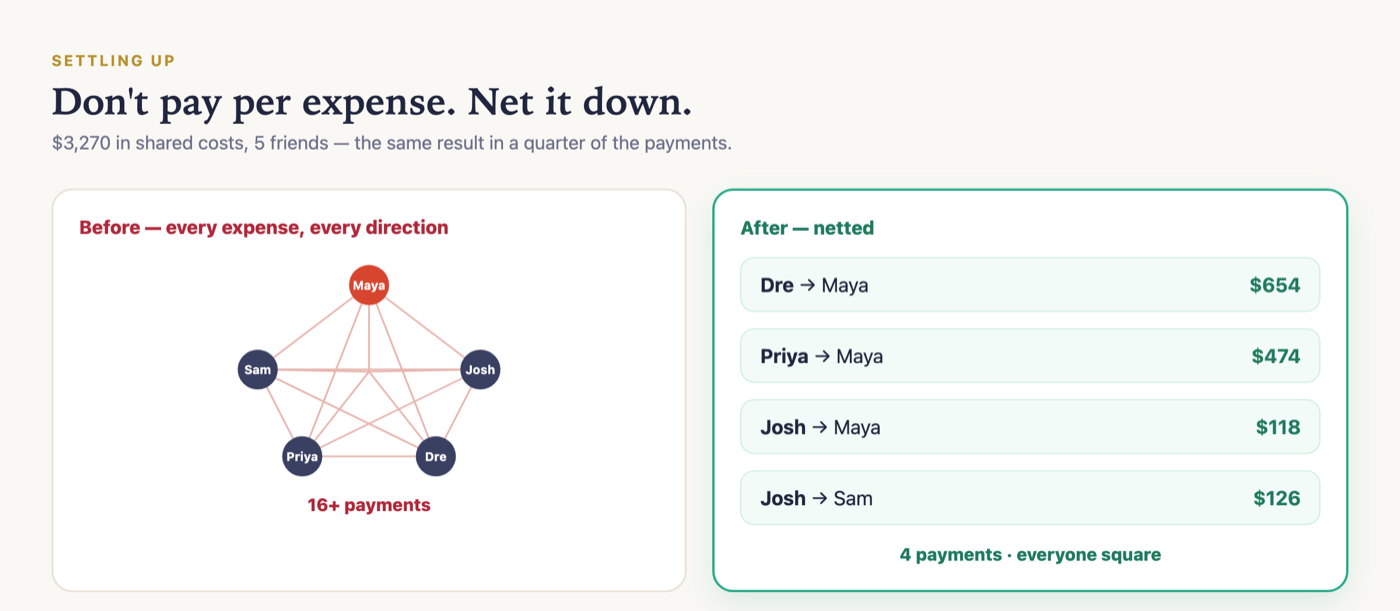
Here's where most groups faceplant at the finish line. The naive way to settle is per-expense: everyone pays back each payer for each thing. Five people, a dozen shared expenses: that's potentially 16+ separate payments flying in every direction, each one a chance for someone to forget.
The right way is netting: total what each person paid, compare it to their fair share, and let one balance per person fall out. Then route the minimum number of payments. Real example: five friends, $3,270 in shared costs (fair share: $654 each):
| Person | Paid out | Fair share | Balance |
|---|---|---|---|
| Maya | $1,900 (the house) | $654 | is owed $1,246 |
| Sam | $780 (dinners + boat fuel) | $654 | is owed $126 |
| Josh | $410 (groceries + gas) | $654 | owes $244 |
| Priya | $180 (brunch + tickets) | $654 | owes $474 |
| Dre | $0 | $654 | owes $654 |
Instead of a web of per-expense paybacks, the whole trip settles in four payments:
- Dre → Maya: $654
- Priya → Maya: $474
- Josh → Maya: $118 and Josh → Sam: $126
Everyone's square. Maya gets her $1,246 back in three payments instead of chasing four people across a dozen line items. (This netting math is exactly what a settle-up feature automates: the arithmetic isn't hard, it's just the kind of thing nobody wants to do at 11pm on a Sunday.)
Then: everyone pays within 48 hours of the tally. Set that expectation when you share the numbers ("here's the final tally, let's all square up by Tuesday"). If someone's payment doesn't land, you're in different territory. Here's what to do when a friend owes you money after the trip, scripts included, friendship intact.
What mistakes should you avoid when splitting trip costs?
Seven ways good crews go wrong, ranked by how often we've seen them:
- No method agreed before money moved. The root cause of 80% of trip-money drama. Ten minutes, four decisions, pinned message. (Scroll up.)
- Splitting the sticker price instead of the real price. Cleaning fees, service fees, taxes and damage deposits routinely add 25–30% to a vacation rental's nightly rate. Split the checkout total, not the listing price, and decide upfront who eats the deposit if it doesn't come back.
- The head-count split on wildly unequal rooms. The sofa-bed person will not say anything. The sofa-bed person will simply never come on a trip with you again. Price the rooms.
- Auditing the small stuff. If you're itemizing a $6 iced coffee, the system has failed. Communal pot for the small shared stuff, itemize only big opt-ins. The $2 you "lose" on any given day is the fee for staying friends.
- Letting the fronter be the ledger. One person's memory is not a source of truth, and "I think you owe me around $300?" is not a sentence friendships enjoy. Shared, written, same-day.
- Letting IOUs ride. Money owed decays into money resented at about week two. Tally within a week, paid within 48 hours of the tally.
- Forgetting the no-shows and early-leavers. Someone cancels three weeks out. Who covers their share of the non-refundable house? Decide the policy at booking (standard: your spot, your share, unless you find a replacement), not mid-crisis.
FAQ
What is the fairest way to split costs on a group trip?
A hybrid: split true shared costs (groceries, gas, the rental car) evenly, split lodging by room quality using weighted shares, and itemize only large optional activities that not everyone joined. Agree on the method before anyone pays for anything.
Should couples pay more than singles on a group trip?
For lodging, couples pay per room share: one good bedroom is one good bedroom, whether one or two people sleep in it, so weight by room and split that room's share between them. For everything else (food, activities, transport), a couple is two people and pays two full shares.
Should you split a group trip evenly if people did different activities?
Split the shared foundation evenly, but itemize big opt-in extras. The useful threshold: anything over about $50 per person that less than the whole group did (the boat charter, the spa morning) gets split only among the people who did it. Below that, even-split and let it wash out.
How do you collect money from friends before a group trip?
Set a per-person deposit at booking (25–50% of the lodging share works for most trips), name a deadline, and collect before the fronter's card gets charged; a paid deposit is also the most reliable RSVP ever invented. Full playbook: how to collect money for a group trip.
What's the best way to track shared expenses on a trip?
Whatever the whole crew can see and someone will actually update same-day: for a simple weekend, a shared spreadsheet can do it; for anything longer or bigger, a purpose-built tracker that records who paid and runs the settle-up math wins. Here's our honest spreadsheet vs app comparison.
Keep reading: the group-money series
This guide is the hub for our group-money playbooks:
Or skip the spreadsheet entirely. Everything in this playbook, the split rules, the who-paid ledger, the netted settle-up, is what Limbo does out of the box. Every core online trip workflow is free; server-controlled Pro offline access adds supported offline work when enabled and recently verified. Your friendships stay priceless.